- HoH Presents
- Posts
- Ink & Artifact Vol 1Tolkien vs. Sanderson: World-Building Approaches Explained
Ink & Artifact Vol 1Tolkien vs. Sanderson: World-Building Approaches Explained
How Two Fantasy Giants Shape Entire Worlds in Wonderfully Opposite Ways

John Harrison
June 04, 2025 • Estimated Reading Time: 12 minutes

MEET TODAY’S TOPIC
In the vast and verdant cosmos of fantasy literature, few names shine brighter than J.R.R. Tolkien and Brandon Sanderson.
They are titans of their genres, architects of the impossible, weaving worlds so rich, intricate, and immersive that they transcend mere escapism and become alternate realities unto themselves. Their methods—their blueprints for creation—could not be more different. One builds myth with the resonance of ancient song; the other engineers worlds like a clockmaker dreams of planets. This is a tale of two creators: one, a philologist of Middle-earth; the other, a systems thinker of the Cosmere.
Hey there!
Welcome to a new installment of In & Artifact — a thoughtful journal of craft, myth, and imagination. Here we unpack the bones of storytelling, lift the veil on world-building, and talk about the magic behind the magic. Every issue brings insight into how tales are told — and why they stay with us long after the final page.
Today, we’re stepping into the luminous footprints of two giants. Let’s dive in.
THE BONES
The Mythopoeic Legacy of Tolkien
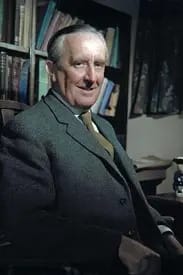
Tolkien didn’t just write stories. He composed legends. His world-building wasn’t born of a need to populate a plot; it was born from a deep, abiding love of language, myth, and the ancient texts that sang to him across centuries. Middle-earth emerged not as a backdrop, but as a living entity—a tapestry of cultures, histories, and tongues, each woven with painstaking care. His was not a world built for a story, but a world from which stories organically arose.
Tolkien's languages came first: Quenya and Sindarin, crafted with academic rigor and poetic grace. From these came peoples, then histories, then wars, and finally the tales of hobbits and kings. In this way, Tolkien practiced what he called "sub-creation": a divine echo of the Creator’s act, a reverent artistry that sought to mirror the majesty of our own world through imagined parallels.
Every stone in Middle-earth has a memory. Every forest echoes with forgotten songs. Consider the Ents, ancient tree-herders whose language takes days to convey a single thought—they are not plot devices but expressions of a worldview where age, memory, and growth are sacred.
Tolkien's work feels unearthed rather than invented. His maps read like archaeological sites, his timelines like biblical genealogies. He was not merely a world builder; he was a lore keeper of a world that could have been.
Sanderson's Scientific Fantasia
Brandon Sanderson, by contrast, approaches world-building like a cosmic engineer. Where Tolkien reaches backward into myth, Sanderson reaches outward into possibility. His Cosmere—a sprawling interlinked universe of magical systems and planetary cultures—is constructed with the precision of a physicist and the ambition of a galactic historian.
His rules are clear. His systems are defined. In Mistborn, magic is based on ingesting metals; in Stormlight Archive, it's fueled by stormlight and the bonds between spren and humans. These aren’t vague mystical forces—they are ecosystems of cause and effect, underpinned by laws that could almost be charted, tested, and peer-reviewed.
Sanderson’s famous "laws of magic" (most notably: "An author’s ability to solve conflict with magic is directly proportional to how well the reader understands said magic") highlight his commitment to clarity and structure. This is a kind of narrative engineering—magic as machinery, plot as architecture.
And yet, within this structure, Sanderson does not lose sight of wonder. His magic does not dispel the mystery of his worlds; it enhances it. He paints the sky with glowing glyphs and lets living storms rage across shattered plains. He anchors us in rules only to lift us into awe.
Where Tolkien's world invites reverence, Sanderson's dares us to explore. One is cathedral; the other is observatory.
Tolkien’s work feels unearthed rather than invented. His maps read like archaeological sites, his timelines like biblical genealogies. He was not merely a world builder; he was a lore keeper of a world that could have been.
Comparing the Pillars: Contrasts and Complements
While Tolkien and Sanderson may seem to reside on opposite ends of the fantasy spectrum, their worlds aren’t at odds—they are in dialogue. These authors illuminate two radically different philosophies of creation, each offering a unique lens through which to see not only fantasy, but our own world. What follows is a breakdown of their core contrasts—not as binaries, but as complementary facets of the world-builder’s art.
Language vs. Logic For Tolkien, language is not only a means of communication but the seed of civilization. Words carry sacred weight. The shaping of Quenya and Sindarin wasn’t a flourish—it was the genesis. Language is what gives culture its cadence, myth its memory, and identity its roots. The Elves do not merely speak; their speech is a kind of music. Their worldview is linguistically encoded. In Sanderson’s work, logic is the loom from which magic systems are woven. He does not begin with tone or tale, but with principles—clear, bounded, testable. His magic systems function like metaphysical science: ingest metal, gain abilities; bond with a spren, gain powers. Culture in the Cosmere often arises in reaction to or in symbiosis with these systems. Society is scaffolded atop mechanism. Both approaches offer depth, but their goals diverge. Tolkien wants to evoke ancient memory—a world you feel you’ve always known, like a half-remembered dream. Sanderson wants to provoke fresh curiosity—a world where discovery awaits behind every rule yet to be uncovered. Tolkien teaches us to remember the myth that never was. Sanderson invites us to engineer the future myth we’ve yet to imagine. | Mystery vs. Mechanism This vagueness is intentional. Tolkien believed that over-explaining magic diminishes its mythic power. In his world, magic is entwined with the fabric of being itself—interwoven with destiny, heritage, and the sacred. It resists taxonomy and rewards reverence. Sanderson, on the other hand, turns magic into mechanism. His systems are complex but knowable, mysterious at first glance but always awaiting explanation. In Stormlight Archive, Kaladin’s journey is as much about emotional growth as it is about mastering the measurable mechanics of surgebinding. Readers can diagram his powers, track his progress, and anticipate the consequences of his choices. This doesn't remove the magic—it refines it, gives it friction. Tolkien’s magic is alchemical: mystical and veiled, rooted in ancient essence. Sanderson’s is chemical: structured, catalytic, reactive. One whispers; the other demonstrates. |

Lore vs. Design Tolkien's world feels grown, like a forest; Sanderson's feels constructed, like a city. But that isn’t to say one is artificial or the other untamed—both have their own organic truths, rooted in their creators’ visions of how story and structure intertwine. Tolkien’s lore unfolds like strata of ancient earth—layer upon layer of myth, memory, and ancestral depth. His histories stretch back millennia, not to serve the plot, but to birth it. You don’t just hear of Númenor—you feel its echo in the grief of Aragorn, the pride of Boromir, the ruins scattered across the map. Middle-earth exists beyond the frame of the narrative; the story is merely a sliver of what once was and still might be. Sanderson, meanwhile, designs worlds like precision-crafted machinery. His cultures and conflicts are not grown over centuries of imagined time but engineered to reveal tension, evolution, and insight within the bounds of the narrative. That’s not to say his worlds lack depth—they teem with lore—but this lore is interwoven with utility. It moves. It functions. It propels. Where Tolkien is a cartographer of the mythic past, Sanderson is an urban planner of speculative futures. One makes you feel as though you’re discovering ruins; the other, that you’re exploring blueprints come to life. | Reverence vs. Resilience Tolkien’s characters often wrestle with fate, legacy, and the burden of ancient evil. They are torchbearers of long histories, called not just to act, but to remember—and in remembering, to carry forward the weight of the world. Frodo bears the Ring not merely as a magical object, but as a symbolic inheritance of corruption and sacrifice. Aragorn doesn’t simply claim a throne—he must prove himself worthy of the echoes of Númenor and Elendil. Theirs is a reverence for what came before, a sense of duty wrapped in poetry and prophecy. Sanderson’s heroes, meanwhile, are born into broken systems and scarred selves. They do not inherit grand legacies—they claw meaning from chaos. Kaladin fights not just with Stormlight but with depression, guilt, and trauma. Vin learns to trust after a life of betrayal. Dalinar must atone for the violence of his past to lead with integrity. These are not elegies—they are stories of healing. Of reclamation. Of becoming. Where Tolkien sings of noble sorrow, Sanderson sings of survival. One leans into the elegiac, honoring what was lost. The other bends toward the redemptive, daring to believe in what might still be found. |

In the end, both Tolkien and Sanderson craft characters who carry burdens—but the nature of those burdens reveals what each author reveres. One honors the deep gravity of legacy; the other honors the struggle of becoming whole. These different emotional timbres offer us a broader spectrum of human experience in fantasy: the grief of memory and the hope of transformation. Each reminds us that the worlds we build—whether in fiction or in life—are shaped not just by what we inherit, but by how we rise.
Sanderson’s heroes are born into broken systems and scarred selves. They do not inherit grand legacies—they claw meaning from chaos.
TODAY’S WORKSPACE
What Writers Can Learn from Both
From Tolkien, writers can learn the value of depth: of building beyond the page, of allowing stories to rise from the soil of the world. His work reminds us that narrative can be rooted in reverence—for language, history, and the profound beauty of myth. He teaches us that great fiction doesn’t begin with plot, but with the unseen architecture beneath it: the ancient wars, forgotten songs, and slowly spoken names that cast long shadows across the present.
From Sanderson, writers learn the value of coherence: of designing with intent, of crafting systems that both inspire awe and reward understanding. He shows us that rules need not diminish magic—that in fact, a well-structured system can invite reader participation and emotional investment. His approach highlights that complexity, when wielded with clarity, does not confuse—it captivates.
Tolkien inspires you to dig—into language, lore, and legacy. Sanderson pushes you to design—precisely, imaginatively, and with purpose. One gives you deep roots; the other gives you flexible scaffolding.
Ultimately, great worldbuilding is not about mimicking a method but marrying a vision with a voice. It is not Tolkien or Sanderson. It is the willingness to learn from both—and in doing so, to forge a voice that is unmistakably your own.
 |  |
A Practical Guide for Writers: Applying the Wisdom of Tolkien and Sanderson
So how can you, the writer, apply these towering approaches to your own worldbuilding? Whether you lean toward ancient myth or modern mechanism—or something in between—here are a few grounding practices, drawn from both the masters and echoes of your own evolving work.
Start With What Resonates Deepest
When I wrote Shadow Dance, I didn’t start with a map or magic system—I started with a sound. A phrase that moved like breath through the dark, "'One Day I will be free.' Words spoken to the wind." Tolkien taught me that language doesn’t just describe a world—it awakens it. I was shaping a voice, and that voice whispered a whole realm into being.
What I admire about Sanderson's work is how everything clicks. Magic that obeys rules. Cultures that reflect systems. It’s fantasy with friction, grounded by cause and consequence. That’s what I aim for to add a sense of realism and understanding. I ask: what’s the cost? What’s the chain reaction? Real-world terms—entropy, resonance, inertia—become more than jargon; they’re anchors for belief. Sanderson shows us that the more real your system feels, the more your magic matters.
Start wherever your instincts spark—whether it’s rhythm or rigor, myth or math—and shape your own kind of harmony from the chaos.
Build Systems With Soul
Sanderson builds magic like an architect sketches a bridge—every part with purpose, every force with form. His systems do more than dazzle; they reflect, provoke, and demand consequences. That’s what I try to channel when crafting power in my own worlds: it’s not just what magic does, it’s what it means. Who benefits? Who suffers? What does it strip away?
Magic isn’t just a tool—it’s a mirror. Whether you’re working with divine contracts, elemental currencies, or inner demons made manifest, let your mechanics ask hard questions. Power should always echo its price.
Tolkien, by contrast, weaves magic into the fabric of his world like breath into song. It’s less a system and more a sacred presence—something old, something remembered. His magic resists explanation not because it lacks depth, but because it’s rooted in reverence. When Galadriel offers a phial of starlight, it’s not about mechanics—it’s about meaning. His enchantments glow with memory, grief, and grace. Sometimes, the power of magic lies in its silence, in what it chooses not to reveal.
I try to carry a bit of both into The Shadow Saga. Magic, when wielded by those who understand it, should feel natural—lived-in, almost mundane in its discipline. But when witnessed by outsiders, it should feel like wonder incarnate. That balance between internal logic and external awe is what keeps the magic alive—for the characters, and for the reader.
Blending these approaches means knowing when your magic should click—and when it should haunt.
Let History Shape Identity
Tolkien’s histories aren’t just backdrop—they're bone-deep. Legacy isn’t something characters read about; it's something they carry in their blood. A sword, a song, a shame—every relic in Middle-earth is soaked in meaning. That’s what I aim to echo in The Shadow Saga. My characters aren’t just shaped by events—they’re haunted by echoes. A forgotten name can unravel trust. A half-remembered prophecy might still pull the strings.
Sanderson, too, understands how the past molds the present—but he often reveals it through scars and systems. His characters learn history not through lineage but through confrontation: personal trauma, cultural upheaval, broken institutions. I try to bridge both. My goal is to let history speak through the unspoken. Through customs, silences, the way a character hesitates before a lie they've inherited.
True worldbuilding remembers—and lets that memory ache, adapt, and ripple outward.
Combine Texture and Tension
Tolkien’s textures are tactile—mossy ruins, smoke-curled pipe-weed, ancient songs half-lost to time. His world breathes through detail, through slow quiet moments and spaces that feel weathered by story. Sanderson, by contrast, builds his tension like pressure systems in a storm—rules colliding, ideologies sparking, characters pushed to the edge of system and self.
In my own work, I try to let texture do more than paint the scene. A decaying temple isn't just atmospheric—it's a cultural wound. A cracked stained-glass window might reflect both faith lost and truth refracted. At the same time, I let tension simmer just beneath. What happens when a sacred space becomes a site of betrayal? When beauty hides pressure?
By drawing from both Tolkien’s atmospheric immersion and Sanderson’s tightly wound stakes, I aim to build worlds readers can feel—but make sure they’re always just one heartbeat away from breaking.
You can do this too: choose one setting and ask yourself what it smells like, what’s decaying, what’s been forgotten. Then layer in friction—what's the unresolved conflict in that space? Who’s avoiding who, what tension lies beneath the surface? The more sensorial and conflicted a moment becomes, the more your world will live on the page.
Design Your Own Pillars
YTolkien leaned into light and shadow—divine echoes, ancient falls. His pillars are often archetypal: good versus evil, destiny versus choice, decay versus renewal. Sanderson, on the other hand, builds from tension: law versus loophole, faith versus fracture, identity versus institution. His pillars are structural, thematic, and often interrogate the systems characters move through.
But you don’t need to borrow their pillars—you need to discover your own.
For me, The Shadow Saga dances between secrecy and selfhood. What’s hidden, and what’s becoming. That dialectic shapes everything: how my characters wield power, how time feels in the world, how even healing can fracture or bind. It’s less about themes and more about gravitational forces—what pulls everything inward, and what threatens to tear it apart.
So define your gravity. Maybe it’s freedom vs. faith. Memory vs. momentum. Let that internal contradiction bleed into your maps, your magic, your myth.
That’s where voice meets vision. That’s where worlds begin to matter.
In the end, it’s not about choosing between Tolkien’s reverence and Sanderson’s resilience—it’s about building a world that honors your own myth, your own logic. Let every map, law, and legend be a reflection of your creative fingerprint.
Want to go deeper?
Check out the companion blog post that inspired this guide:
Tolkien vs. Sanderson: Worldbuilding Approaches Explained
The Symphony and the Machine
Imagine worldbuilding as music. Tolkien composes a symphony—ancient, swelling, and full of hidden harmonies. Sanderson constructs a synthesizer—precise, modern, and infinitely customizable. One hums with age-old echoes; the other pulses with controlled chaos.
Both are beautiful. Both are art. And both, when done right, move us to believe that other worlds are not only possible—they are inevitable.
So whether you walk the long road to Rivendell or soar on a lash of stormlight above Roshar, know that you are treading paths blazed by master builders. One carved in rune and root; the other in circuit and spark.
And maybe, just maybe, the best way forward is to carry a bit of both in your pack.
Productivity isn’t about location. It’s about habits and mindset.

FINAL THOUGHTS
Beyond the Map
Whether you favor the deep echo of elvish ballads or the crisp crunch of Allomantic metals, there’s something profoundly human in the act of world-building. It’s how we question, remember, and reimagine our place in the cosmos. Tolkien reminds us that wonder can be ancient, heavy with memory. Sanderson shows us it can be fresh, built piece by piece from radiant curiosity.
Great stories do more than entertain — they invite us to inhabit. They ask us to believe in something that doesn’t exist, only to reveal something that always has.
So take what you will from these two giants. Borrow a rune from Tolkien’s twilight grove or a surge from Sanderson’s stormlit sky. The path you blaze will be your own. But let it be wide enough for wonder, and deep enough for truth.
Until next time — keep building, keep imagining.Remote work and travel are both about freedom—if you plan wisely, you can have both.
Enjoyed this piece?
If this exploration of fantasy world-building sparked your imagination, consider sharing it with a friend who loves stories as much as you do. You can:
Forward this newsletter
Share on social media with the hashtag #InkAndArtifact
Or tag us directly: [@HoHPresents]
Every share helps us reach more thoughtful readers who believe that words still matter, and that worlds are worth building.
Thanks for being here.
-the HoH Presents Family
Reply